Jura & three lakes region Solothurn
Solothurn
Plan your trip
A handcrafted itinerary for Solothurn.
SleepFind your stay
A short, curated list. None of them a chain.
GuidesFollow a route
Hand-curated, walked before written.
Solothurn sits at the southern foot of the Jura, on the banks of the Aare, roughly 40 kilometres northwest of Bern. With around 16,800 residents, it is the capital of the canton bearing its name and among the smallest cantonal capitals in Switzerland.
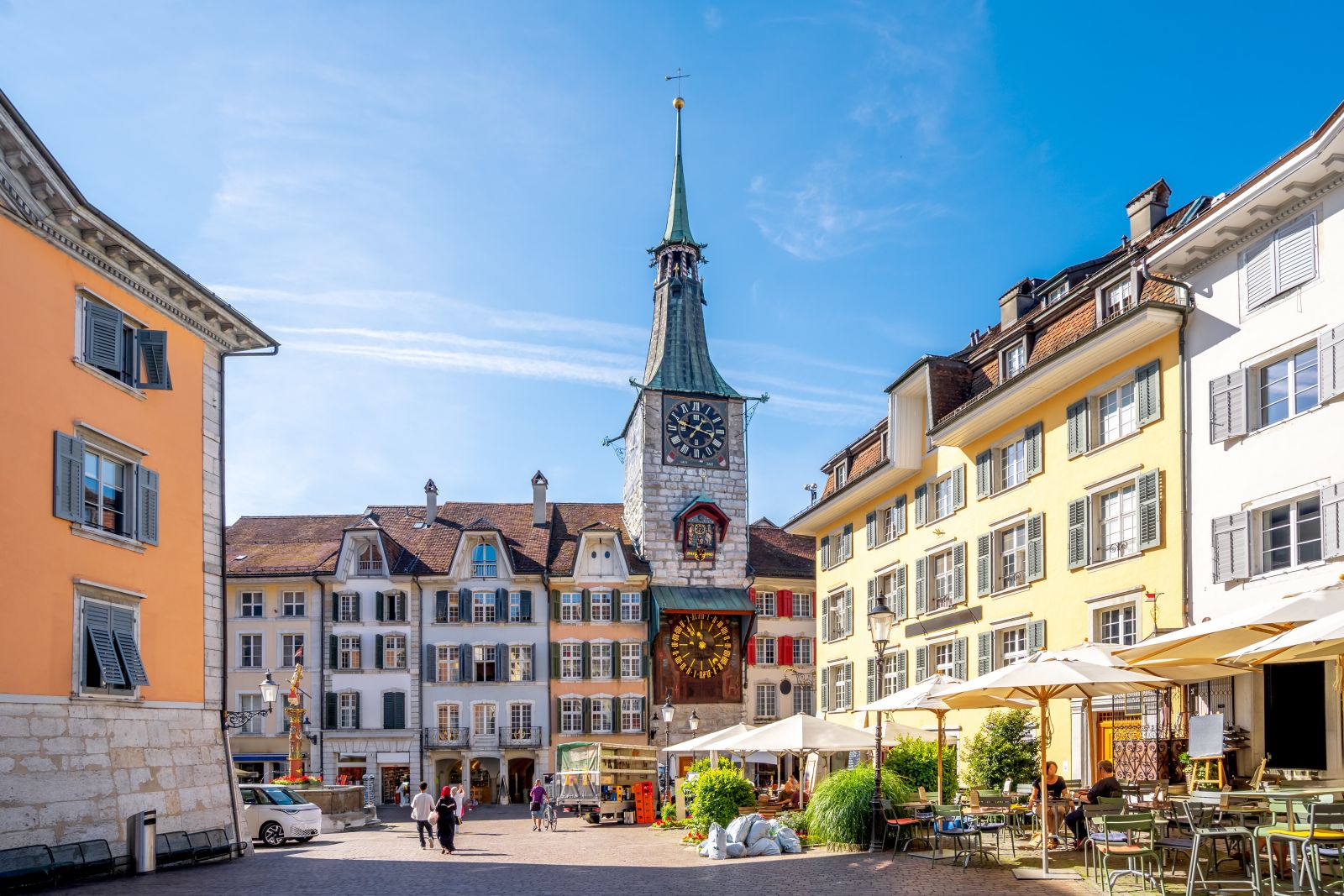
The old town, largely built between 1530 and 1792 when Solothurn served as the residence of the French ambassador to the Swiss Confederacy, is car-free and considered the country's most complete example of Baroque urban architecture. Eighteen buildings here carry heritage protection. The St. Ursus Cathedral, completed in 1773, dominates the skyline with its clock tower and eleven bells.
Behind the town rises the Weissenstein, a 1,395-metre summit in the Jura, reachable by gondola from Oberdorf and offering a clear line of sight to the Bernese Alps on a good day.
What makes Solothurn slow travel perfect
Solothurn is a town built around a number. Eleven altars in the cathedral, eleven historic fountains, eleven towers along the old fortifications, a clock on Amthausplatz with only eleven hours on its face, even a local beer called Öufi, eleven in the Solothurn dialect.
Nobody can fully explain why the number took hold in the Middle Ages, and that unresolved detail is part of what keeps visitors looking closer rather than moving on. The old town rewards a slow pace by design. Cars are banned after 11:30 in the morning, so the Baroque façades along Hauptgasse and the market stalls on Märetplatz, set up every Wednesday and Saturday, are met on foot. The Aare runs along the edge of town with a clarity that surprised even locals who grew up nearby, cold and pale green, moving fast enough to feel alive but calm enough to sit beside for an hour without checking the time.
Above the rooftops, the Weissenstein offers the counterpoint: a gondola ride from Oberdorf replaces what used to be a chairlift, and the summit trades cathedral bells for wind and, on clear days, a horizon of Alpine peaks. Between the two, a short walk through the Verena Gorge leads to a hermitage built into the rock, still inhabited, a reminder that Solothurn's quiet has held for centuries longer than most tourist itineraries.