Switzerland has over 5,000 kilometres of railway. Most of it is ordinary. These five lines are not. These are not journeys you take to get somewhere faster. They are journeys you take because the train itself is the point. Because the valley below deserves more than a glance. Because some landscapes only make sense when you move through them slowly, from a window, without a plan for what comes next.
The Gornergrat Railway, Zermatt
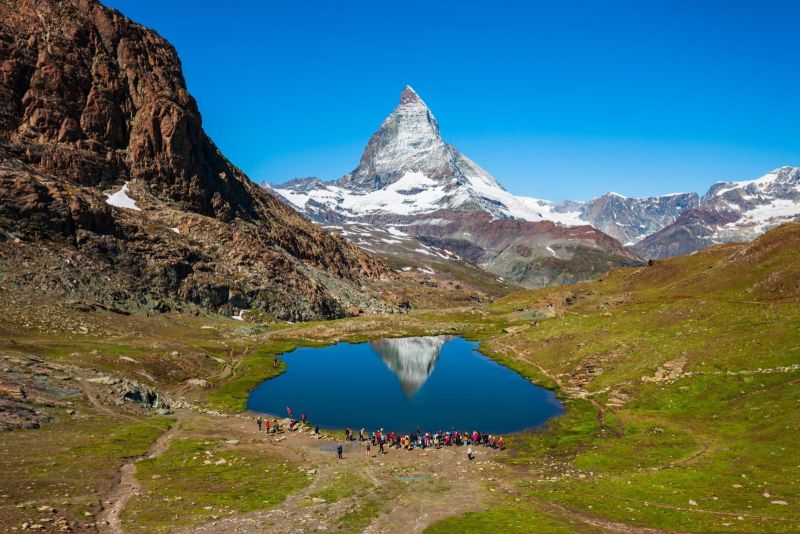
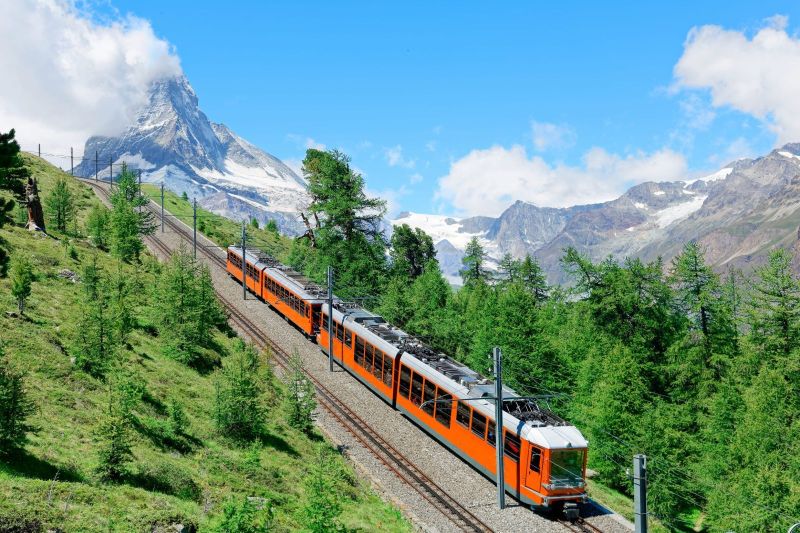
At 3,089 metres, the Matterhorn fills the entire right side of the window. Not a postcard version of it. The actual thing, close enough to make the scale feel wrong.
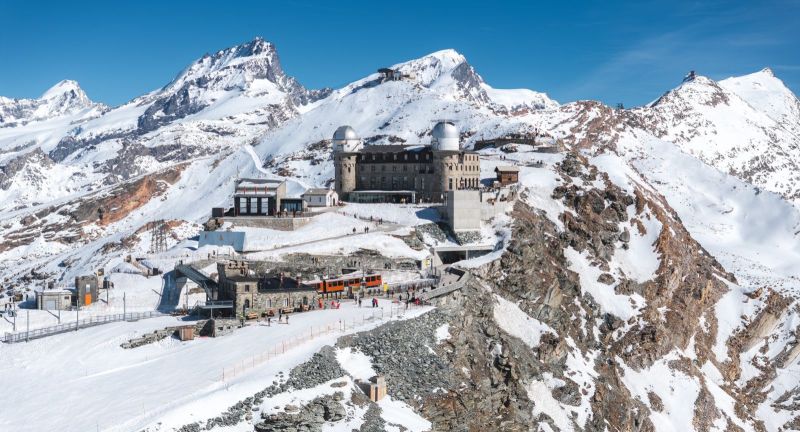
The railway has been running since 1898, Switzerland's first fully electric rack railway. It departs from Zermatt at 1,604 metres and climbs through pine forest, past the treeline, into open alpine terrain that becomes increasingly bare. The ascent takes under an hour. The gradient does not relent.
Bonus:
Take the last train up in the evening and sleep at the 3100 Gornergrat Kulmhotel. The day visitors are gone. The mountain at dusk, with longer shadows and no crowd, is a different thing from the mountain at noon.
The Glacier Express, Zermatt to St. Moritz
291 bridges. 91 tunnels. Eight hours.
The Glacier Express runs between two of Switzerland's most iconic mountain towns, crossing the cantons of Valais, Uri, and Graubünden. The landscape shifts every hour: vineyards, gorges, pine forests, the open plateau of the Engadin.
The Landwasser Viaduct appears at full speed. Six arches, 65 metres above the valley floor, built directly into a cliff face. It is gone before you have processed what you saw. That moment is worth the whole trip.
First class has a restaurant car where the tables are angled toward the panoramic windows. Order a glass of Valais wine somewhere after the Oberalp Pass. Put the phone away. Pick one valley and watch it the way you watch something you might not see again.
Jungfrau Railway to Wengen
There are no roads into Wengen. There have never been roads into Wengen.
The village sits at 1,274 metres on a wide south-facing terrace above the Lauterbrunnen Valley. Everything arrives by train: groceries, furniture, building materials, visitors. The car-free status dates to 1899. The absence of engine noise changes the quality of the air.
Below, the Lauterbrunnen Valley is one of the deepest in the Alps. Seventy-two waterfalls drop from its walls. From Wengen, the Jungfrau, the Mönch, and the north face of the Eiger sit directly across the valley. The Jungfrau railway continues up from here to the Jungfraujoch at 3,454 metres, the highest railway station in Europe.
The Jungfraujoch is worth doing once. Wengen is worth returning to.
Bernina Express, Chur to Tirano
This is the only line on this list that ends in another country.
The Bernina Express runs from Chur through the Engadin valley, over the Bernina Pass at 2,253 metres, and down into Tirano in northern Italy. Four hours. Two countries. A vertical descent of more than 2,000 metres. The line is UNESCO World Heritage, built in the early 1900s using 196 bridges and 55 tunnels, without a single metre of rack-and-pinion track. The engineers went over the pass without a shortcut.
Near the end of the descent comes the Brusio spiral viaduct: the track curves in a full circle to manage the gradient. It looks like a problem that should not have a solution. It works anyway.
Travel southbound in late spring. Snow on the pass. Palm trees in Tirano. Italy begins in the middle of a sentence, and you will feel it before you see the border sign.
Pilatus Bahn, Alpnachstad to Mount Pilatus
The steepest cogwheel railway in the world. 48 percent gradient. Every two metres forward, the train rises almost one metre. You feel it in your seat.
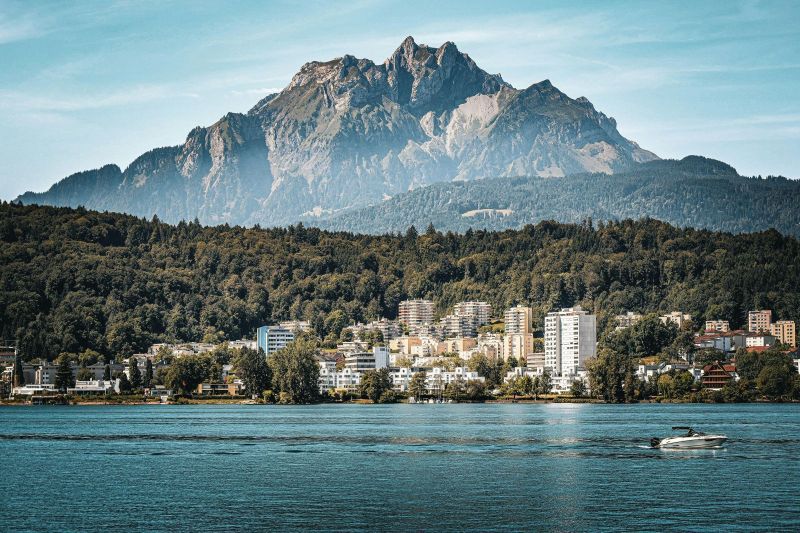
Do not drive to Alpnachstad. Take the paddle steamer from Lucerne instead, the way the journey was designed to be done. Boat to the base, cogwheel to the summit, aerial cable car down to Kriens. Three modes of transport. One mountain. The approach matters.
The line opened in 1889. At 2,073 metres the summit looks north across the Swiss Mittelland and south into the Alps. On clear days, six lakes are visible at once. The mountain is named, according to local legend, after Pontius Pilate, whose restless ghost was said to haunt its peak. Whether you believe that or not, there is something in the air up there that is hard to name.
On how to travel these lines
All five journeys can be done as day trips. None of them should be.
The Gornergrat deserves a night in Zermatt before or after, when the village empties and the mountain stays lit. The Glacier Express deserves a slow morning at one end and a slow evening at the other, with the eight hours in between treated as the destination. Wengen deserves a bed and an early alarm.
Switzerland built its railways to move people efficiently through difficult terrain. These five lines did something else. They made the terrain the point.